
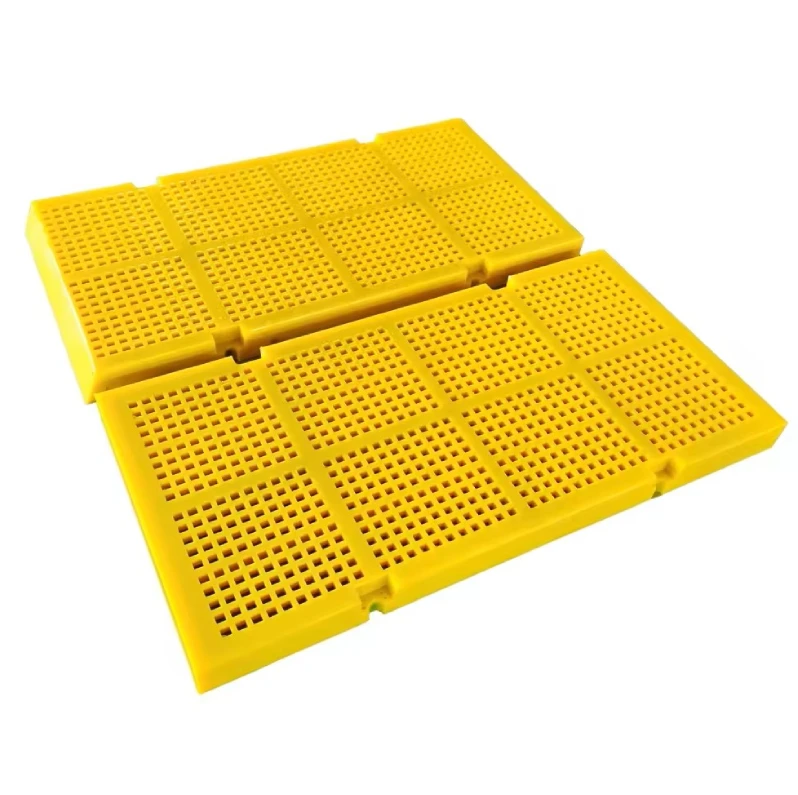
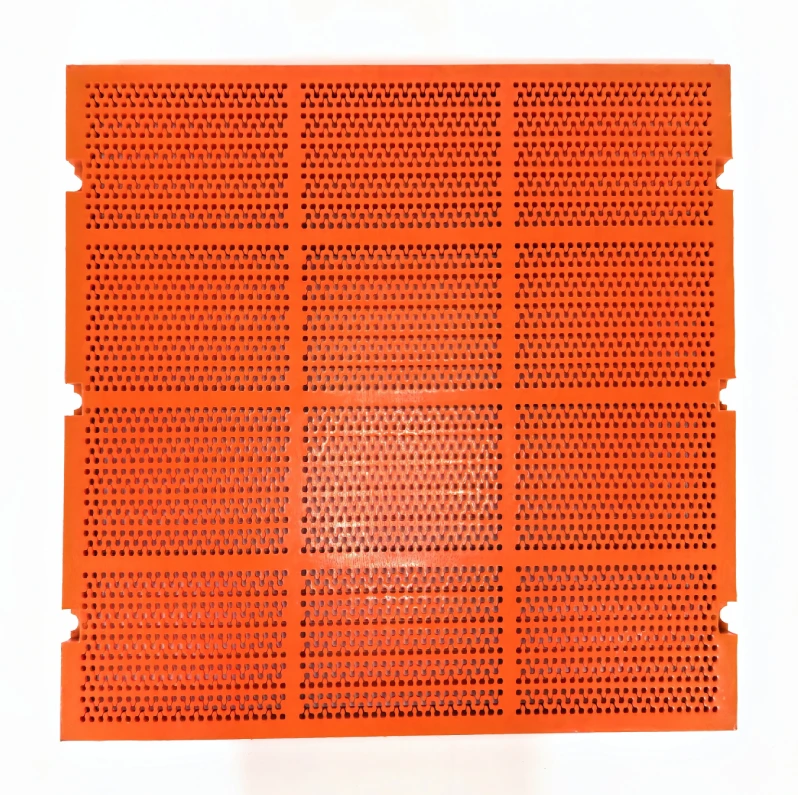
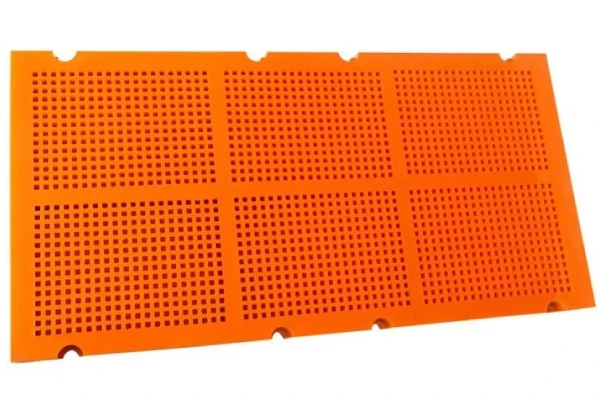

Bolted Screen Plate
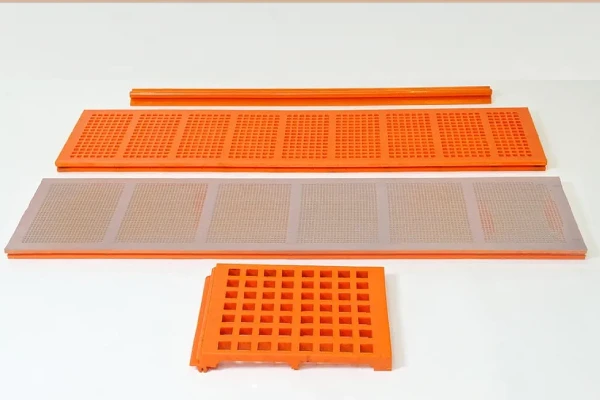
The Bolted Screen Plate is manufactured from premium polyurethane with M20-M24 high-strength bolts (≤300mm spacing). Delivers ≥300J/cm² impact resistance, withstanding 500kg-class blocks. Achieves >80% sieving rate with ≤5% error. Heat-resistant below 150°C.
Product Detail
Superior Impact Resistance: With impact resistance of ≥300J/cm², this polyurethane screen plate withstands repeated impacts from 500kg-class large blocks without tearing, deformation, or structural failure. Polyurethane’s inherent elasticity absorbs and dissipates impact energy, preventing crack propagation that would destroy rigid metal or rubber plates.
High Throughput & Accuracy: The square hole design follows the principle “hole width = 1.5 × material particle size.” This ratio minimizes “bridging,” where large blocks align across openings and block material flow—a common problem in coarse screening. The bolted fixation prevents screen plate displacement under heavy loads, maintaining screening accuracy with error ≤5%.
High-Temperature Capability: Specialized polyurethane formulation maintains stable performance below 150°C, making it suitable for screening high-temperature metallurgical slag and other hot materials that would degrade standard polyurethane or rubber screens.
Industry Applications

Mining (Run-of-Mine Waste Rock Removal)
Ideal for removing waste rock from run-of-mine ore before primary crushing. Polyurethane withstands 500kg-class block impacts while achieving >80% sieving rate. The 1.5× particle size hole ratio minimizes bridging of large, irregular rocks.
Construction & Demolition Recycling (Waste Classification)
Perfect for removing stone powder clumps from manufactured sand. The micro-bending rod action dislodges agglomerated fines, achieving ≤5% blinding rate even with moist feed. Cleaner sand product improves concrete workability and quality.
Metallurgy (High-Temperature Slag Screening)
Suitable for screening up to 150°C metallurgical slag from steelmaking processes. Specialized heat-stabilized polyurethane maintains dimensional stability and mechanical properties in hot environments where standard plastics would soften.

FAQ
Why polyurethane instead of steel for heavy impact applications?
Polyurethane offers a unique combination of properties that often outperform steel in heavy impact screening:
Impact absorption: Polyurethane’s elasticity (typically 300-500% elongation) absorbs impact energy and returns to original shape, while steel can permanently deform
No crack propagation: Steel develops micro-cracks that grow under repeated impact; polyurethane’s molecular structure prevents crack propagation
Lighter weight: Polyurethane plates weigh approximately 1/6 of steel plates, reducing strain on screen box and vibrating mechanisms
Corrosion immunity: Polyurethane never rusts, ideal for wet or chemically aggressive feeds
For 500kg-class block impacts, the combination of bolted fixation and thick-section polyurethane provides reliable service life equal to or exceeding steel.
Why is the formula "hole width = 1.5 × material particle size" important?
In coarse screening, a common problem is “bridging” or “arch formation”—elongated or irregular particles align across an opening too narrow for them to pass, blocking the hole and reducing sieving rate. By setting hole width to 1.5× the target particle size, two benefits occur:
Material that should pass (≤ target size) has ample clearance
Material that should not pass (> target size) is less likely to form stable bridges because the opening is proportionally wider relative to particle length
This optimizes both throughput and accuracy, achieving >80% sieving rate with ≤5% error.
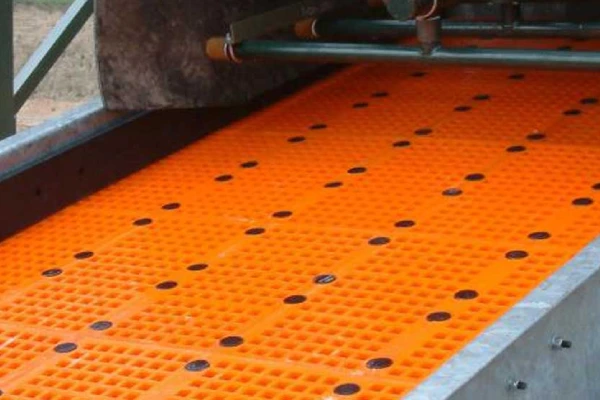
How does the bolted fixation compare to clamped or tensioned mounting for polyurethane screens?
| Mounting Type | Advantage | Disadvantage |
|---|---|---|
| Bolted | High stability | Longer installation |
| Clamped | Fast installation | May loosen |
| Tensioned | Quick changeover | Light-duty only |
What does "screening error ≤5%" mean in practice?
Screening error refers to the percentage of misplaced material—oversize particles that pass through (contaminating undersize fraction) or undersize particles that report to oversize (reducing recovery). A ≤5% error means at least 95% of particles are correctly classified. For run-of-mine waste rock removal, this accuracy ensures valuable ore is not rejected with waste (reducing losses) and waste is not sent to the crusher (reducing unnecessary wear).
How does polyurethane maintain stability at 150°C?
Standard polyurethane begins to soften above 80-100°C. The Bolted Screen Plate uses a specialized heat-stabilized polyurethane formulation incorporating isocyanate modifiers and thermal stabilizers that cross-link to maintain dimensional stability up to 150°C. While the material becomes slightly more flexible at high temperatures, it retains its tear resistance and impact strength necessary for heavy-duty screening.